
Curriculum organisation
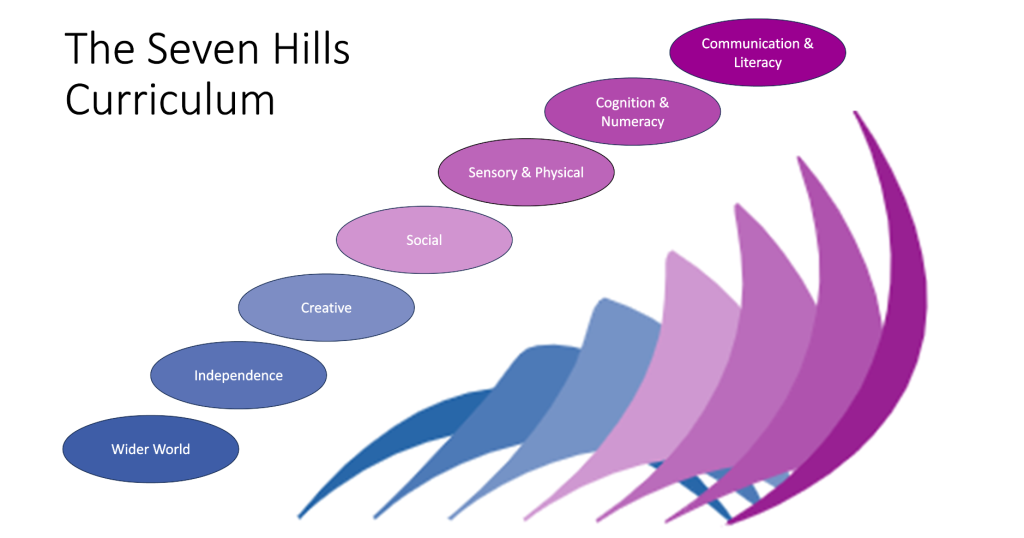
At Seven Hills School we aim to promote curiosity and enthusiasm in our students, encourage them to become independent learners and to develop their confidence for life beyond school and in preparation for adult life in the 21st century. The vision for our school’s curriculum is to provide a fully inclusive curriculum that gives students the opportunity to achieve their full potential by engineering a curriculum that best meets each student’s diverse needs. Students access a broad and balanced education, based on the realities of modern life and delivered in a personalised learning environment. The Curriculum is not solely what we teach, it is how we focus on what is key to the learning needs of each student to enable them to have as rich and fulfilled a life as possible, both now and into the future. We strive to develop learning environments outside the confines of the classroom, promoting learning through positive outdoor experiences and play.
The implementation of the curriculum is made accessible and appropriate by clearly identifying a student’s needs and stage of development, ensuring the learning environment closely matches their needs. Our curriculum runs on four curriculum pathways; Dynamic, Discovery, Investigation and Enquiry.
All curriculum pathways are delivered through a personalised approach built upon our curriculum foundations. Students are assessed before entering the school to determine which pathway would best suit them and to enable individual needs to be met through the inclusive curriculum. Curriculum pathways will allow learning journeys to start from individual pupils’ current strengths and needs. The pathway selected will depend upon the student’s needs and long-term goals. We avoid rigid placement within a pathway and movement between pathways is possible following a re-evaluation of a student’s needs and progress.
We use the whole range of curriculum subjects to provide breadth of experience and opportunity. These experiences act as vehicles and are delivered through a personalised approach focused on individual outcomes. This approach maximises engagement in learning, ensures access to learning is personalised and rich and meaningful experiences support individual outcomes. The curriculum is implemented through contextual learning experiences where students are supported to generalise their skills across a range of learning opportunities. Teaching styles and pedagogy vary according the needs of the students, with an emphasis on developing independence across all pathways.
We have high expectations and for our students to match these, they will need to access, interact with and problem solve the world around them. Our curriculum is designed to enable each child, at their own level, to rise to this challenge and celebrate their achievements. Our careful tracking and measurement of the impact of our curriculum on individual progress, evidences the achievements children make, how these reflect our high expectations and how we prepare them for the future. We foster a culture of collaborative assessment that enables staff to maximise pupil progress by purposefully and effectively using data from different strands to inform teaching and learning.
Our school is fortunate to benefit from specialist areas such as a food technology room, hydrotherapy pool, rebound trampoline, soft play, science garden, woodland walk and the rainbow garden.
Educational visits and visiting artists further enrich our curriculum or all pathways. In addition to this, the curriculum is further enhanced through the implementation of academic and therapeutic interventions delivered either 1:1 or in small groups.